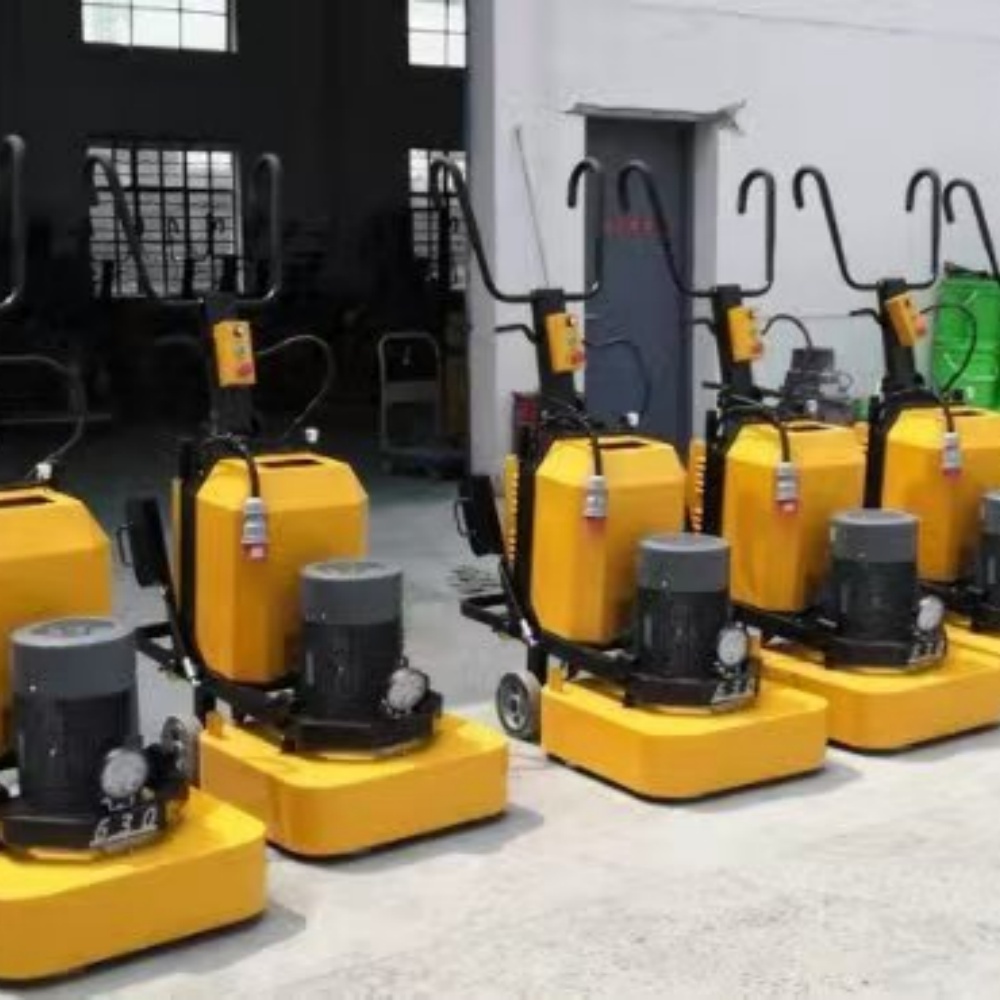
In industrial flooring, building renovation, and concrete surface treatment projects, the choice between dry grinding and wet grinding has always been a hot topic. What may seem like a simple difference of “with or without water” actually involves fundamental distinctions in grinding principles, performance, application scenarios, and cost structures. This article breaks down the core differences between dry and wet grinding, helping contractors and project managers make more informed equipment and process decisions.
- Process Principles: The Root of the Differences
Dry Grinding
Dry grinding relies on direct friction between diamond abrasives and the concrete surface without any liquid medium. Dust generated during grinding is typically captured by the machine’s built-in dust extraction system. The main advantages are:
- Simple workflow with no need for water supply or wastewater treatment
- High mobility and quick setup
- Suitable for a wide range of small to medium-sized projects
Wet Grinding
Wet grinding uses water or a special coolant to lubricate the cutting area, reduce heat, and suppress dust. The concrete slurry formed by the mixture of water and grinding debris is usually collected by a wet vacuum or recovery system. The presence of water changes the grinding environment, resulting in:
- Lower heat and reduced abrasive wear
- Better surface finish and fewer deep scratches
- Higher material removal rates in certain applications
- Performance Comparison: A Data-Driven View
2.1 Grinding Efficiency and Material Adaptability
- Dry Grinding
◦ Faster overall workflow for small to medium projects, as there is no need for water preparation, cleaning, or drying time.
◦ Generally 1.5–2 times faster than wet grinding for thin coating removal and light leveling.
◦ Better control on relatively soft concrete (below 20 MPa), with typical grinding depth ≤ 0.1 mm and lower rework rates.
- Wet Grinding
◦ More efficient for high-hardness concrete, thick coating removal, and deep leveling.
◦ Material removal rate can be 30–40% higher than dry grinding under similar abrasive consumption.
◦ Water lubrication helps maintain a more stable cutting action, especially on dense, hard concrete.
2.2 Surface Finish and Gloss Control
- Dry Grinding
◦ Preferred when a high-gloss, mirror-like finish is required.
◦ By using resin-bond abrasives from 3000 to 5000 grit, it is possible to achieve a gloss level of over 90 GU (comparable to or even higher than some marble surfaces).
◦ Commonly used in showrooms, high-end offices, and commercial spaces where appearance is critical.
- Wet Grinding
◦ Excels at producing a fine, uniform matte or low-sheen finish.
◦ Typical wet grinding with 800–3000 grit abrasives can eliminate metal marks and achieve a subtle 25–35 GU gloss.
◦ Better at improving overall flatness and reducing surface defects such as sanding marks and pitting.
2.3 Abrasive Life and Cost Structure
- Wet Grinding
◦ Cooler operating temperatures significantly extend abrasive life. Metal-bond diamond tools can often last up to 500 m² per set, reducing abrasive costs by about 40% compared to dry grinding.
◦ Requires additional investment in water supply, wet vacuums, and slurry management, increasing initial equipment costs by 20–30%.
- Dry Grinding
◦ Abrasives wear faster due to higher heat and friction.
◦ No water or wastewater treatment costs, and the surface is ready for subsequent treatments (such as concrete densification) immediately after grinding, reducing overall project time and labor costs by 15–20%.
2.4 Environmental and Safety Performance
- Wet Grinding
◦ Effectively suppresses dust, capturing over 90% of concrete particles.
◦ Silica dust levels can be controlled below 0.1 mg/m³, helping meet occupational health and safety standards and reducing the risk of silicosis.
◦ Easier to comply with strict environmental regulations, especially in factories, hospitals, and schools.
- Dry Grinding
◦ Generates large amounts of dust, requiring a high-efficiency dust extraction system.
◦ Poor dust control can lead to equipment damage, rework, and health risks.
◦ Maintenance and filter replacement for dust collectors can account for 10–15% of total project costs.
- Application Scenarios and Selection Matrix
When to Choose Dry Grinding:
- Small to medium indoor projects (e.g., convenience stores, offices) where dust control is manageable and fast completion is a priority.
- Projects requiring a high-gloss, mirror-like finish (showrooms, retail spaces, exhibition halls).
- Soft or weak concrete surfaces where excessive water could cause damage or delay subsequent treatments.
- Upper floors or locations without convenient water supply and drainage, or where waterproofing is a major concern.
When to Choose Wet Grinding:
- High-hardness concrete, thick coating removal, or deep leveling projects.
- Environments with strict environmental and health requirements (factories, hospitals, schools, food processing plants).
- Projects where a fine, uniform matte finish is preferred.
- Large, open areas with proper water supply and wastewater disposal facilities.
Advanced Approach: Combined Dry + Wet Grinding
For complex projects, many professionals use a “wet grinding for base preparation + dry polishing for final gloss” approach:
- 100–3000 grit wet grinding to remove defects, level the surface, and create a fine, scratch-free base.
- 3000–5000 grit dry polishing to enhance gloss and achieve up to 90% of a full mirror finish.
This hybrid method can reduce overall abrasive consumption and dust emissions by about 35% while balancing finish quality and cost efficiency.
- Industry Trends and Practical Recommendations
- Dry Grinding Trends
◦ Development of more efficient dust extraction systems and intelligent temperature control.
◦ New high-temperature calcined abrasives reduce dust generation by around 30% and improve impact resistance by up to 40%.
- Wet Grinding Trends
◦ Integration of grinding, grading, and slurry recovery systems into more compact, user-friendly machines.
◦ Improved wastewater recycling technologies help reduce environmental impact and operating costs.
Practical Tips for Contractors:
- Look at the substrate: hardness, flatness, and existing coatings.
- Look at the project requirements: desired gloss level, environmental standards, and site conditions.
- Look at the budget: equipment investment, labor costs, and maintenance expenses.
When possible, conduct a small-scale test grind to evaluate both methods and determine the optimal process, or consider a combined dry-wet approach for the best balance of speed, finish quality, and cost.
In conclusion, dry grinding and wet grinding are not mutually exclusive, but rather complementary processes with their own strengths. Understanding their differences and selecting the right method for each project is key to achieving high-quality results while maximizing efficiency and profitability. As concrete grinding technology continues to advance, the boundaries between dry and wet processes will likely become even more blurred, offering contractors more flexible and sustainable solutions.