
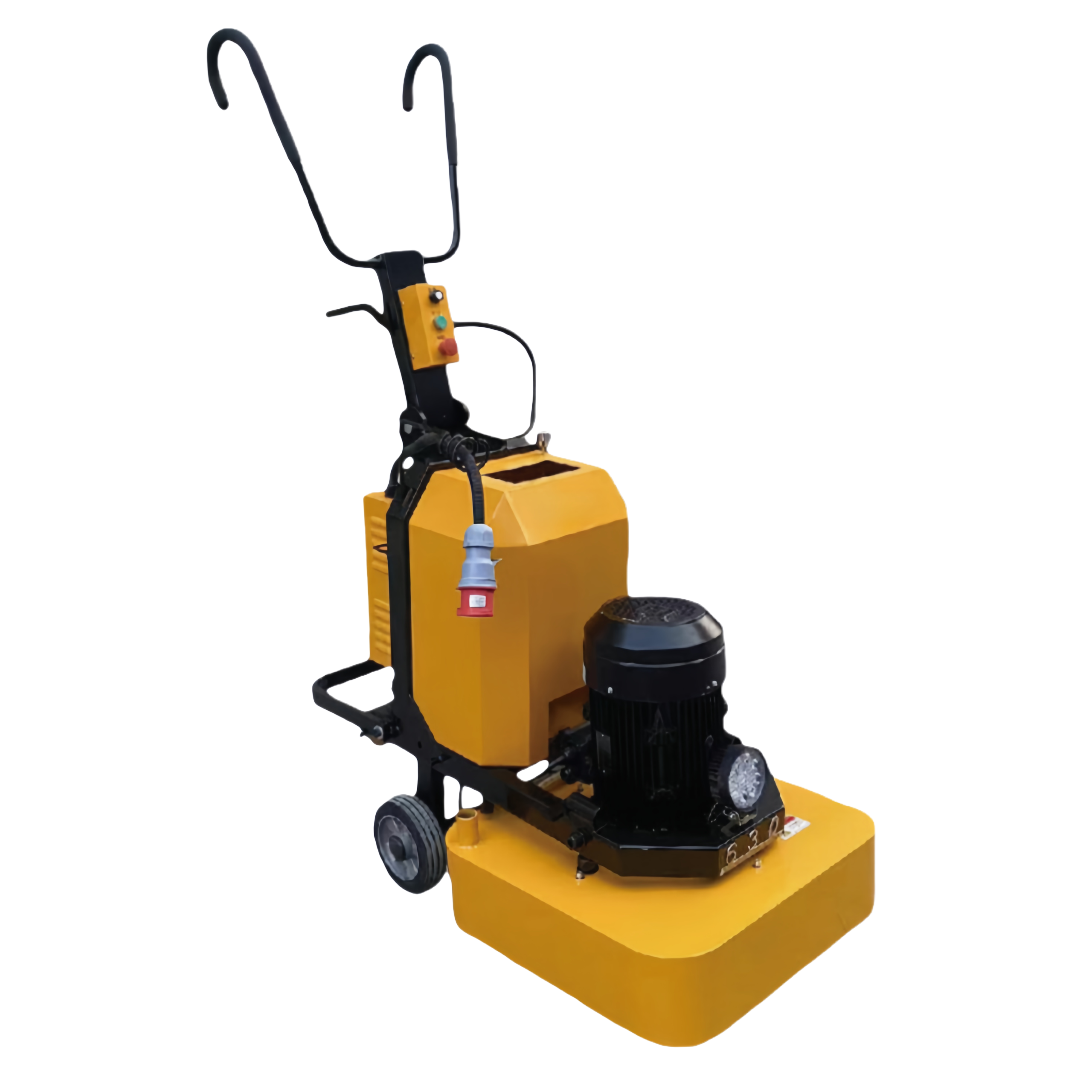
In the floor construction field, the three core scenarios of factories, shopping malls and underground garages have significant differences in usage requirements, spatial layout and ground standards. The selection and adaptation of floor grinders and process design have become the key to determining construction efficiency and project quality. Selecting the right equipment model and matching scientific grinding processes can increase the operating efficiency of a single device by 30%-50%, while reducing rework rates and construction costs. This article disassembles the grinder adaptation schemes and efficiency improvement skills for the core needs of the three scenarios, providing practical guidelines for floor construction.
Industrial Factories: Efficient Grinding + High-Hardness Forming as the Core Under Heavy-Load Operation Requirements
As areas for the frequent operation of heavy equipment and vehicles, industrial factories have stringent requirements for the flatness, hardness and wear resistance of the ground. Grinding construction needs to balance large-area rapid processing and ground strength forming, and the key to adaptation lies in the strong matching of equipment power and grinding disc technology.
Key Points for Grinder Adaptation
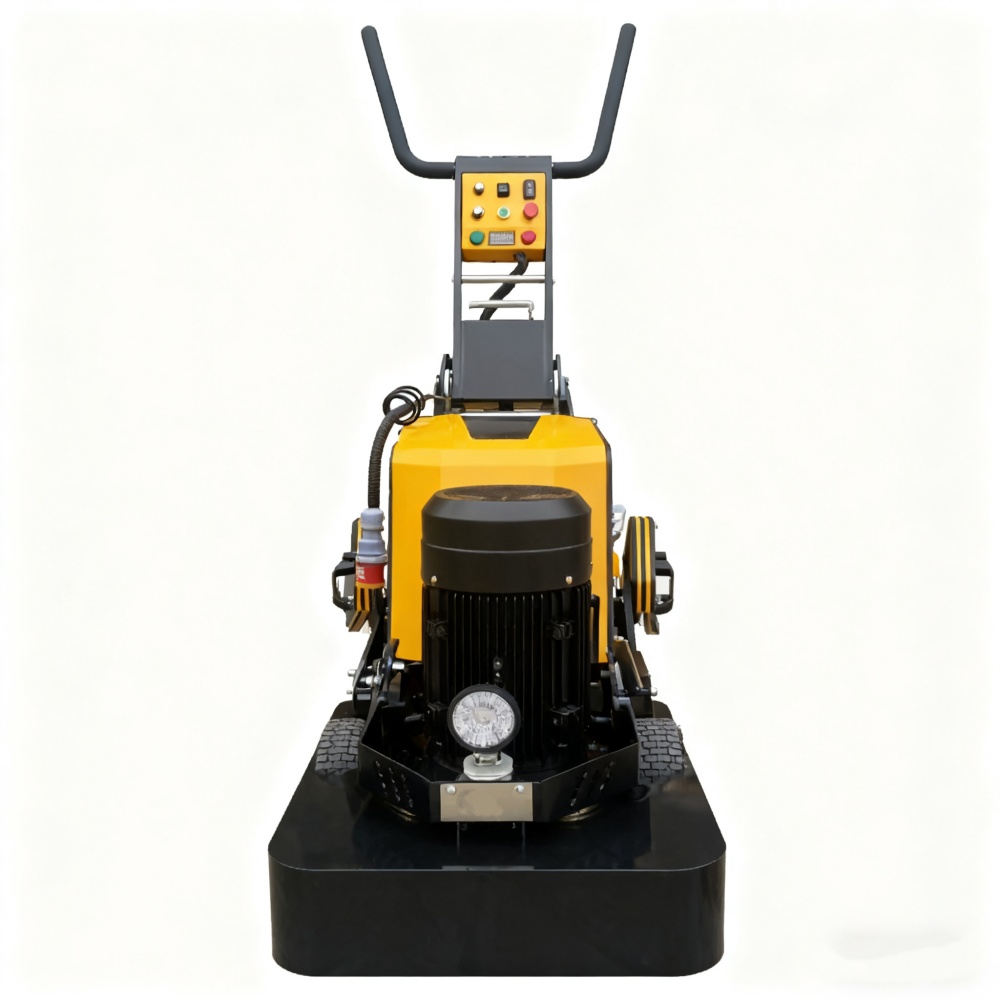
Prioritize ride-on planetary grinders (grinding width ≥800mm, power ≥15kW) or large-sized hand-held planetary grinders. Their multi-grinding disc design enables uniform grinding, avoiding the swirl mark problem of single grinding discs, with a single device achieving an hourly operating area of 80-100 square meters, suitable for the large-area construction needs of factories with tens of thousands of square meters. For corner areas, match with hand-held edge grinders (power ≥1.2kW) to solve the grinding dead ends in narrow spaces such as columns and wall corners, realizing full-area dead-end-free processing.
Efficiency-Improving Processes
- In the rough grinding stage, use 4-6mm thick diamond grinding discs with a grid-shaped grinding path, overlapping 1/3 of the grinding disc width each time, to quickly correct ground height differences of more than 3mm, with a daily processing capacity of up to 600 square meters;
- Grasp the 30-45 minute golden window period for curing agent construction, spray and grind in a timely manner to make the material penetration depth reach 2-3mm, and the ground hardness rise to above Mohs 6, comparable to granite;
- Adopt the dry grinding process throughout, matched with an industrial vacuum cleaner with suction ≥20kPa, which can not only accurately control the grinding mark depth, but also avoid dust affecting workshop equipment, and reduce the curing time after wet grinding.
Shopping Malls: Combining Aesthetics and Texture, Fine Grinding + High-Gloss Forming Create High-End Floors
As commercial spaces, shopping mall floors not only require basic flatness, but also have high requirements for glossiness, aesthetics and delicacy. Grinding construction needs to achieve scratch-free high-gloss forming. The key to adaptation lies in the flexibility of equipment and the refined matching of grinding discs, balancing construction efficiency and visual effects.
Key Points for Grinder Adaptation
Prioritize medium-sized hand-held planetary grinders (grinding width 600-640mm, power 7.5-12.5kW). The equipment has a flexible body, which can adapt to diverse spaces such as mall atriums, passages and shops. The planetary grinding disc can achieve uniform grinding, laying a foundation for high-gloss polishing. For the fine areas around glass display cabinets and columns in shopping malls, small planetary grinders (grinding width about 500mm) can be matched to accurately control the grinding force.
Efficiency-Improving Processes
- Adopt the dry-wet mixed grinding process. Use 3-4mm medium-thick grinding discs for wet grinding in the rough and medium grinding stages, which reduces the dust concentration by 80%, and extends the service life of the grinding discs to 500 square meters per set, reducing costs by 40%. For the fine grinding and polishing stages, replace with 1.5-2mm thin grinding discs for dry polishing, making the ground reflectivity exceed 90GU, far exceeding the 80GU reference value of marble, creating a crystal-level high-gloss effect;
- Gradually increase the mesh number of grinding discs (50→200→400→1500→3000) from the medium grinding to the fine grinding stage, with a spiral grinding path expanding from the center to the surrounding, overlapping 50mm in adjacent areas, completely eliminating grinding marks, and the surface roughness approaching Ra0.2μm, reaching twice the smoothness of A4 paper;
- In the polishing stage, use a high-speed polisher (rotating speed 1800r/min) with a wool polishing pad, operate in a field-shaped path, overlapping 1/2 of the polishing width each time, so that the difference in gloss uniformity is ≤5%, improving the overall texture of the shopping mall floor.
Underground Garages: Adapting to Complex Spaces, Flexible Grinding + Anti-Skid Forming Balancing Practicality and Safety
Underground garages have complex spatial layouts with many columns, narrow passages and turning areas, and have high requirements for ground anti-slip performance, flatness and construction period. Grinding construction needs to solve the problems of flexible operation in narrow spaces and rapid delivery. The key to adaptation lies in the compactness of equipment and the simplification of processes.
Key Points for Grinder Adaptation
Core selection of compact planetary grinders (grinding width 400-515mm, power 2.2-4kW) with a compact body and small turning radius, which can flexibly shuttle through garage columns and narrow passages, suitable for local repair and full-area grinding. For the main passage areas of large-sized garages, medium-sized hand-held planetary grinders can be matched to balance efficiency and flexibility; for the surrounding areas of corners and parking space lines, use hand-held angle grinders for refined processing to avoid grinding damage to signs.
Efficiency-Improving Processes
- In the rough grinding stage, use 50-200 mesh diamond grinding discs, adjust the counterweight to 25-30kg, control the traveling speed at 2m/min, quickly handle ground laitance and slight height differences, balancing efficiency and construction accuracy;
- For anti-slip forming, adopt 800-1000 mesh grinding discs for light grinding, retain slight grinding marks to achieve anti-slip effect, no need for additional anti-slip treatment, simplify construction procedures and shorten the construction period;
- Adopt the dry grinding process to avoid water accumulation and slow drying of the ground caused by poor ventilation in the garage. The garage can be opened quickly after construction, the grinding construction time of a single parking space is controlled within 15 minutes, and the overall garage construction efficiency is increased by more than 30%.
Universal Efficiency-Improving Principles for the Three Scenarios, Unlocking the Core Skills of Grinding Construction
- Precise matching of equipment and grinding discs: Select the thickness and mesh number of grinding discs according to scenario requirements, use thick grinding discs for rough grinding to prioritize efficiency, and thin grinding discs for fine grinding to prioritize texture, avoiding rework caused by improper grinding disc selection;
- Dust-free construction as a standard: Whether dry grinding or wet grinding, match with high-efficiency dust collection equipment, use industrial vacuum cleaners for dry grinding and water mist dust reduction for wet grinding, which not only meets the requirements of green construction, but also reduces dust cleaning time;
- Do a good job of base treatment in advance: Clean the ground floating ash and oil stains before construction, repair cracks and holes, and start construction when the strength of the base concrete reaches above C25 and the moisture content ≤8%, avoiding sanding and cracking after grinding from the source;
- Regular equipment maintenance: Clean the grinding disc residue every 2 hours during grinding, check the wear of abrasive grains; clean the equipment in time after construction, detect the carbon brush of the motor, gear box and other core components to ensure the stability of continuous equipment operation.
From the heavy-load efficient grinding of industrial factories, to the high-gloss fine forming of shopping malls, and the flexible construction of complex spaces in underground garages, the scenario-based adaptation of floor grinders is the foundation and process optimization is the core. Only by combining the usage requirements and spatial characteristics of the scenarios, and achieving precision in equipment selection, scientific grinding processes and standardized construction operations, can we truly realize the dual improvement of construction efficiency and project quality, and promote the development of the floor construction industry towards refinement and high efficiency.