
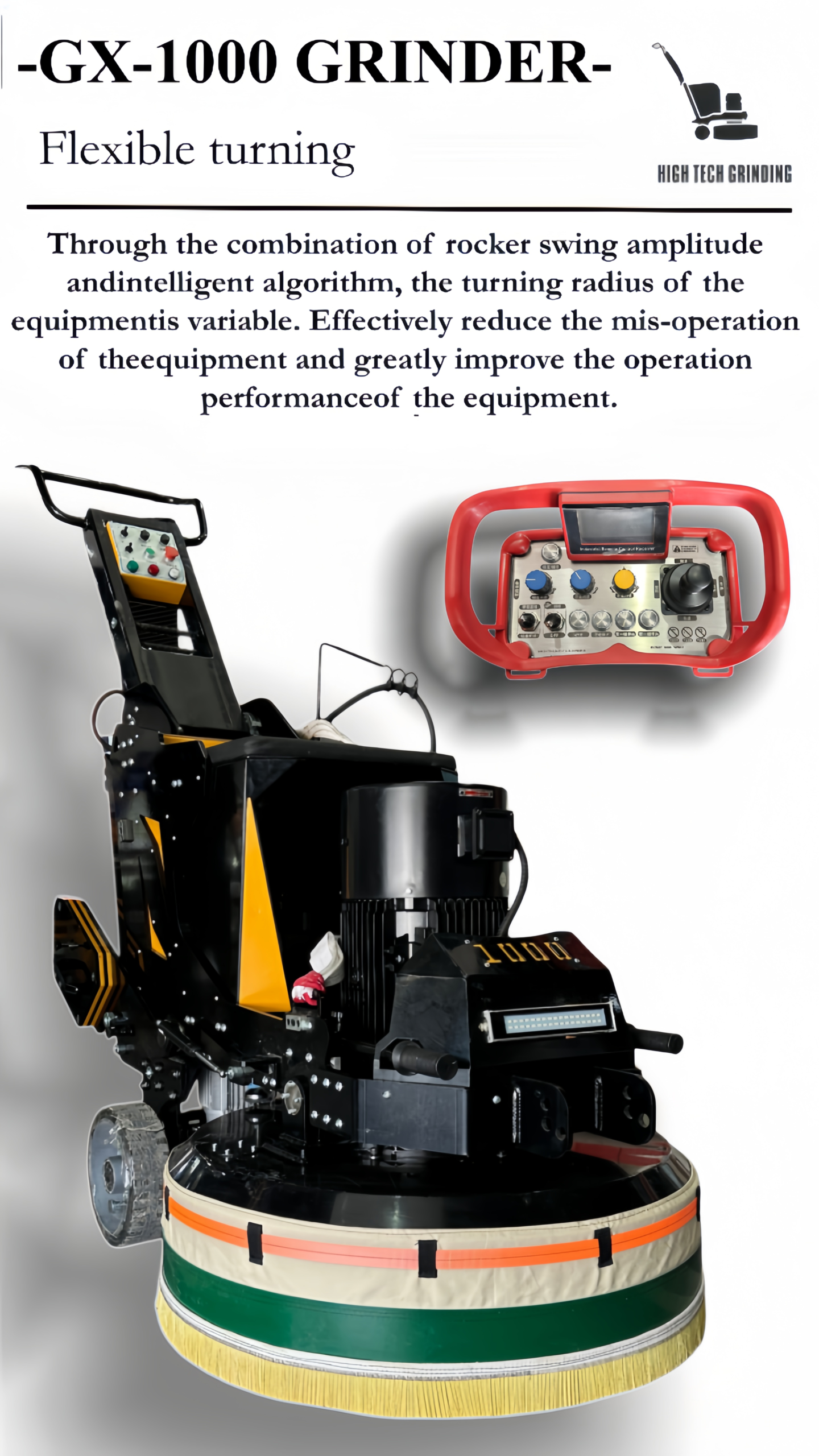
In the fields of building construction, floor renovation, and industrial site maintenance, ground base treatment has always been critical to project quality, service life, and spatial aesthetics. Traditional manual grinding and simple equipment suffer from low efficiency, poor flatness, and severe dust pollution, which can no longer meet the high standards, efficiency, and environmental requirements of modern engineering. The popularization and technological iteration of floor grinding machines have completely transformed the construction model of the ground treatment industry, making them essential equipment for industrial, commercial, and civil ground construction and renovation.
What Is a Floor Grinding Machine?
A floor grinding machine is a professional mechanical device designed for hard surface treatment. By using diamond grinding heads, discs, and other accessories, it performs rotary grinding to level, smooth, polish, remove old coatings, and conduct curing treatment on various hard floors such as concrete, cement, terrazzo, granite, marble, and epoxy floors.
Unlike traditional hand tools, modern floor grinders integrate high efficiency, intelligence, and environmental protection. They can flexibly adjust grinding force, speed, and working modes according to different scenarios, materials, and technical requirements. They can handle large‑area rough grinding efficiently and achieve high‑precision mirror polishing, covering the entire process from new ground base preparation to old floor restoration and industrial floor curing.
Core Application Scenarios
With strong adaptability and practicality, floor grinding machines are widely used across industries:
- Industrial Workshop Flooring
Manufacturing plants, logistics warehouses, and automotive bases require floors to withstand heavy machinery, frequent forklift traffic, and chemical corrosion. Deep grinding and curing via floor grinders greatly improve hardness, wear resistance, and corrosion resistance, preventing sanding, cracking, and damage. They create a level and dust‑free environment that meets strict industrial standards. - Commercial Space Flooring
Malls, hotels, offices, and shopping centers demand high aesthetic, flatness, and easy‑to‑clean surfaces. Grinding machines finely polish marble, terrazzo, and epoxy floors to achieve bright, tidy finishes. During epoxy construction, they refine the base layer to enhance coating adhesion and avoid hollowing or peeling. - Building Construction & Renovation
Base leveling for new residential and public buildings, as well as old community and historic building floor renewal, relies on floor grinders. They quickly fix uneven cement surfaces to prepare for tiles and wood flooring, and efficiently remove stains, damaged coatings, and sandy layers to refresh old floors while reducing time and cost. - Specialized Precision Sites
Food workshops, hospitals, and laboratories require high hygiene and cleanliness. Grinding seals micro‑pores to prevent bacteria and dirt accumulation, simplifying daily cleaning and disinfection. Airports, high‑speed rail stations, and large public areas use large grinders for efficient large‑scale treatment to ensure construction progress and quality.
Core Advantages of Modern Floor Grinding Machines
- Higher Efficiency, Shorter Construction Periods
Multi‑head designs boost efficiency to over five times that of traditional equipment. Single operators can manage large machines, cutting labor and shortening timelines for large‑scale projects. - High Construction Precision & Quality
Accurate control of grinding depth and flatness eliminates unevenness from manual work. Finished floors feature consistent smoothness and gloss for both base preparation and mirror polishing. - Eco‑Friendly & Safe
Most modern grinders are equipped with integrated dust control systems to reduce particulate pollution, meeting environmental standards and protecting workers’ health. Remote and automated models further improve on‑site safety. - Multifunctional & Cost‑Effective
By switching grinding discs and pads, one machine performs rough grinding, fine grinding, polishing, paint removal, and curing. This reduces equipment investment and maintenance costs while adapting to diverse materials and processes. - Intelligent & User‑Friendly
IoT and automation enable real‑time monitoring, predictive maintenance, and automatic operation. Minimal training is required, lowering the skill barrier for operators.
Industry Trends: Intelligence, Eco‑Friendliness & Efficiency
The global floor treatment industry is moving toward green, smart, and efficient construction:
- Dust‑free and low‑energy design becomes standard with optimized dust recovery and energy‑saving motors.
- Automatic and remote‑control machines reduce manual intervention for large projects.
- Lightweight, portable models coexist with heavy‑duty industrial machines for both small home projects and large industrial jobs.
- Improved durability and ease of maintenance lower long‑term operating costs.
Industry data shows concrete flooring dominates the floor grinding machine market, with over 64% of industrial and commercial projects relying on this equipment. Demand will keep rising as urbanization, old renovation, and industrial upgrading continue.
Conclusion
From traditional extensive construction to modern refined and efficient operation, floor grinding machines are more than tools — they drive the upgrading of the entire floor treatment industry. Choosing the right professional grinding machine ensures quality, efficiency, and environmental safety, laying a durable, attractive foundation for all types of sites.
With ongoing technological innovation, floor grinding machines will keep evolving, bringing greater convenience to the construction and flooring industry and supporting a more efficient, eco‑friendly, and intelligent future.