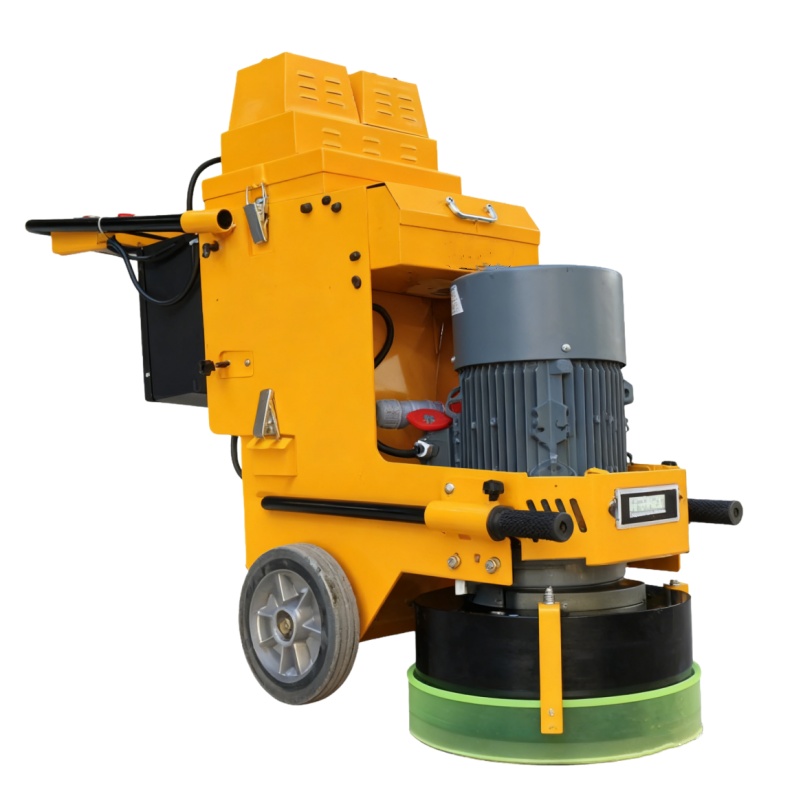
The core competitiveness of flooring construction lies in the grinding disc.
As the “teeth” of the floor grinder, the disc directly determines efficiency, flatness, service life, and overall cost. Entering 2026, innovations including ceramic matrix composites, modular diamond segments, planetary drives, and intelligent adaptive systems have been fully implemented, making rough grinding, leveling, fine polishing, and old floor renovation more stable, faster, and more cost-effective.
Material Revolution: Longer Lifespan with Enhanced Wear Resistance
Industry data shows the application of ceramic matrix composites (Al₂O₃, SiC, ZTA) in high-end grinding discs continues to rise.
With nano-sintering additives optimizing grain structure, flexural strength and fracture toughness are greatly improved over traditional abrasives.
New-generation diamond discs use high-grade 45/50~100/120 mesh diamonds with metal/resin composite bonds, boosting both sharpness and heat resistance.
Surface strengthening technologies such as laser cladding and coating are widely adopted, with coating hardness up to 1200 HV and wear rate reduced by over 60%.
Continuous operation requires fewer disc changes, lifespan extended by more than 30%, downtime is cut significantly, and job site turnover efficiency improves directly.
Structural Evolution: Planetary & Adaptive Systems Eliminate Waves & Missed Spots
Traditional single discs often suffer uneven wear, missed areas, and wavy floors.
Mainstream models in 2026 have fully shifted to planetary grinding discs (rotation + revolution).
Multiple heads work in sync for full coverage, with flatness error controlled within ±0.2mm, meeting high-precision requirements for epoxy self-leveling, clean rooms, and AGV passages.
The breakthrough is intelligent adaptive leveling:
pressure sensors and electric actuators adjust height in real time, automatically compensating for uneven floors.
Dual-motor torque balancing reduces vibration and ensures consistent finishes.
Efficiency on C30 high-strength concrete improves by nearly 10%.
Full-Scene Coverage: One Set of Discs for the Entire Process
New-generation grinding discs feature modular quick-change design for all stages:
- PCD grinding discs: Efficiently remove epoxy, paint, tile adhesive, ideal for old floor renovation
- Diamond segment discs: Level concrete, emery, terrazzo bases, suitable for heavy-duty factories and logistics parks
- Resin polishing discs: Mirror-finish polishing for commercial complexes, exhibition halls, high-end flooring
Wet & dry dual-use, dust capture rate over 95% for green construction.
Lightweight and heavy-duty options are available, suitable for high-rise elevators and large ride-on grinders.
Cost Reduction & Efficiency Improvement: Real On-Site Benefits
- Rework rate reduced from industry average 4% to 0.7%
- Daily output: 800–1200㎡ per machine, construction period shortened by 30%–40%
- Consumable cost per project decreased by 15%–25%
- One-pass flatness meets ASTM and national standards
2026 Selection Guide: Focus on 3 Key Points
- Material: Ceramic or diamond composites for high-strength bases; high-grade resin bonds for polishing
- Structure: Planetary discs for large areas; adaptive constant-pressure discs for uneven old floors
- Matching: Choose discs by machine power, speed, and process to avoid mismatches
Conclusion
The floor grinder disc is no longer just a consumable — it is a core component of the entire construction solution.
Triple upgrades in materials, structure, and intelligence are turning “laborious grinding” into “efficient performance.”
With the new generation of grinding discs, you can improve efficiency, reduce costs, and win projects and reputation with high-quality flooring.
In 2026, make every grind count.