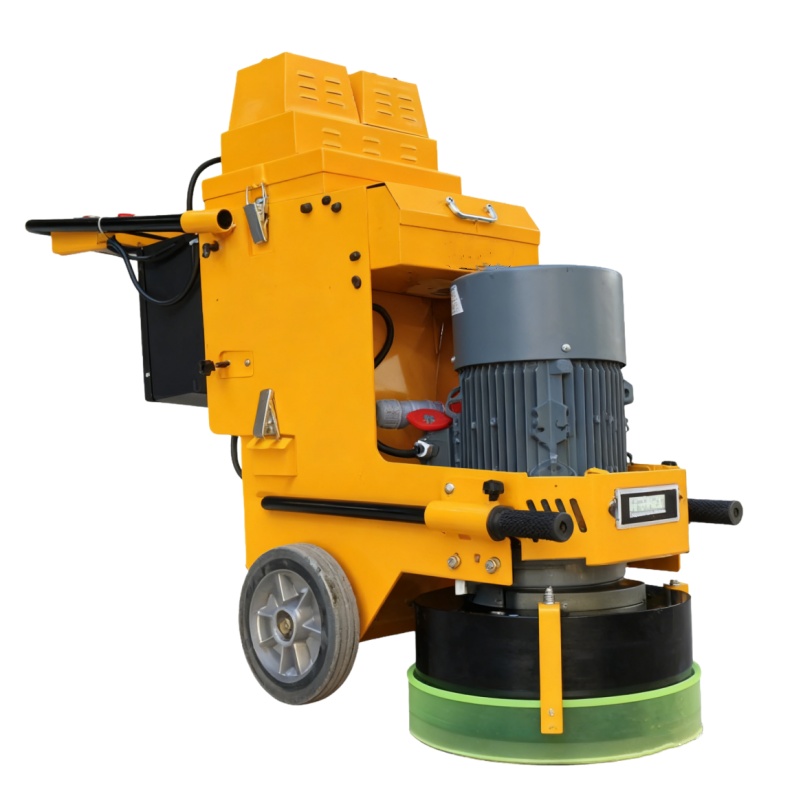
With the surging demand for industrial plant upgrades, commercial space renovations, and urban infrastructure reconstruction, the floor construction industry is undergoing a comprehensive upgrade toward intelligence, green sustainability, and high efficiency. As core equipment for floor engineering, the new generation of floor grinders has completely transformed traditional construction pain points through technological breakthroughs, becoming the focus of the industry in 2026.
I. Bid Farewell to Dust Pollution: Fully Enclosed Dust-Free System Becomes Standard
Traditional grinding operations generate excessive dust, which endangers workers’ health and fails to meet environmental standards. In 2026, mainstream models are equipped with integrated high-negative pressure dust collection modules, featuring a central drive and annular dust collection design. The dust capture rate exceeds 98.6%, far exceeding national environmental requirements. Some high-end models achieve data linkage between the main unit and the dust collection system, adjusting air volume in real time to eliminate dust diffusion at the source, making indoor and outdoor construction safer and cleaner.
II. Intelligent Pressure Control + Leveling Technology: Flatness Error ≤ 0.2mm
The new generation of grinders overcomes the traditional problems of uneven force and easy joint marks. Equipped with constant-pressure planetary grinding technology and an intelligent floating grinding disc system, the equipment can monitor ground hardness in real time and automatically adjust grinding disc pressure. This ensures that the flatness error in large-area construction is controlled within ±0.2mm, perfectly adapting to high-end scenarios such as concrete floor hardening, epoxy flooring, and terrazzo. One-pass forming eliminates rework, significantly improving acceptance pass rates.
III. All-in-One Multifunction: Integrated Design Reduces Costs and Boosts Efficiency
Popular 2026 models feature an all-in-one design, integrating six functions: surface preparation, grinding, edge trimming, polishing, dry grinding, and wet grinding. The modular grinding disc design supports quick replacement, operable by a single person without multiple equipment sets, saving transportation and labor costs. The variable frequency speed regulation system adapts to various working conditions, improving efficiency by over 35% and reducing abrasive disc loss by 22% compared to traditional models, truly achieving cost reduction and efficiency improvement.
IV. Lithium Battery Drive + IoT: Unmanned Construction Becomes a Reality
The popularity of wireless lithium battery technology frees equipment from cable constraints, enhancing mobility by 39% and adapting to complex scenarios such as large factories and underground parking lots. Furthermore, intelligent grinding robots equipped with AI path planning and LiDAR have emerged, supporting 24-hour unmanned operation, automatic obstacle avoidance, and real-time data monitoring. Through the Internet of Things (IoT), remote operation and maintenance and fault early warning are realized, raising overall equipment efficiency to 83% and driving floor construction into the Industry 4.0 era.
V. 2026 Market Trends: Efficiency, Environmental Protection, and Intelligence as Core Competitiveness
Statistics show that the floor grinder market size is expected to reach 1.46 billion yuan in 2026, with high-end models equipped with intelligent systems and dust-free technology accounting for over 40% of sales. Both for domestic projects and overseas exports, low dust, high efficiency, intelligence, and durability have become core procurement criteria for customers.
Choosing a new-generation floor grinder is not just an equipment upgrade but a strategic move to seize market opportunities. Empower construction with technology, win trust with quality, and help every practitioner forge ahead steadily amid the industry’s upgrading wave!