
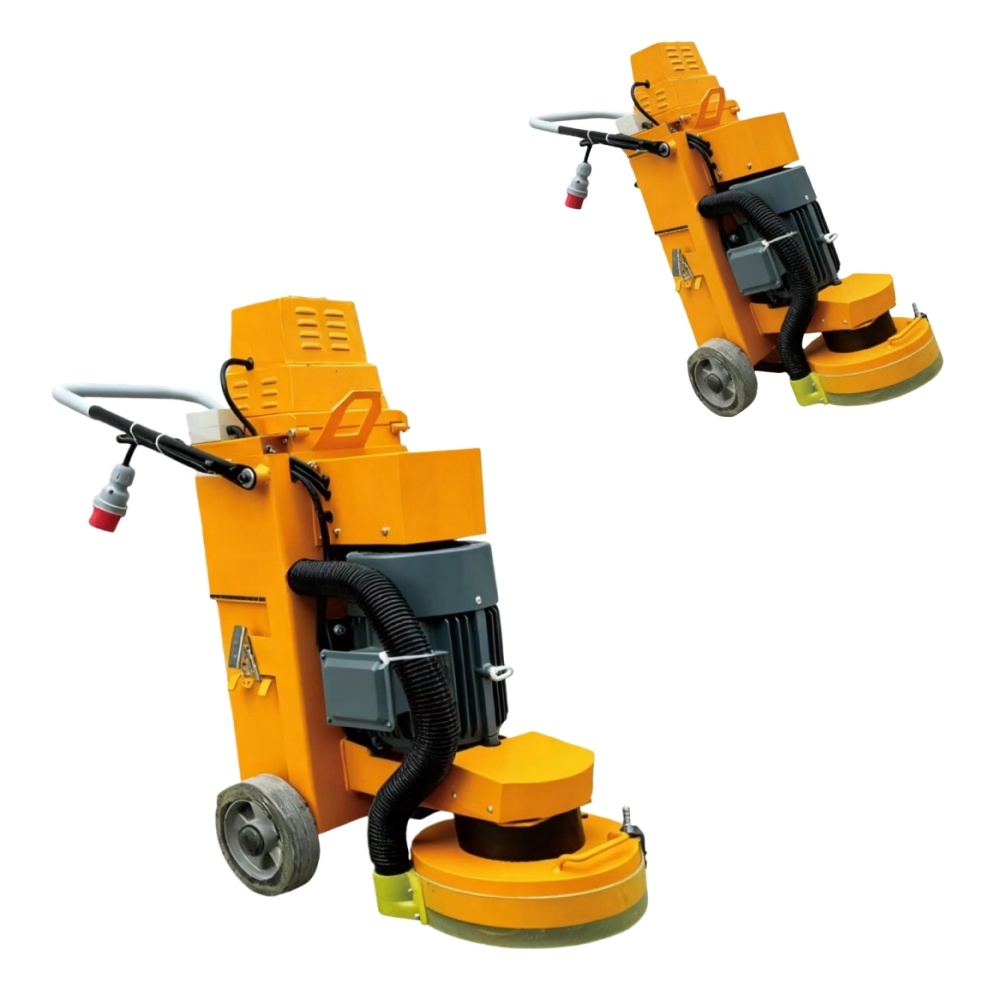
In industrial floor construction, commercial space renovation and other scenarios, the motor performance of concrete grinders directly determines construction efficiency, ground precision and operational costs. As a core technical parameter, motor frequency (fixed/variable) not only differs in design principles, but also profoundly impacts the actual application performance of the equipment. This article analyzes the core differences between the two frequency motors from three dimensions: technical essence, performance comparison and scenario adaptation, providing selection references for industry practitioners.
I. Technical Essence: The Underlying Logic of Fixed and Variable Frequency
The core difference between fixed-frequency and variable-frequency motors stems from the essential differences in power supply methods and frequency control. Fixed-frequency motors are directly connected to the fixed-frequency power supply provided by the power grid (50Hz as the national standard in China, 60Hz in some international regions). Their rotational speed is strictly determined by the power supply frequency and motor pole number. For example, the synchronous speed of a 4-pole motor under 50Hz power supply is fixed at 1500r/min, with the actual speed having only a slip fluctuation of ±2%, making independent speed regulation impossible. This design results in a relatively simple structure of fixed-frequency motors, which only require electromagnetic design matching fixed working conditions, with insulation class mostly B or F, and ordinary enameled wire sufficient to meet the requirements.
Variable-frequency motors convert the industrial-frequency alternating current into frequency-adjustable alternating current (adjustment range usually 0.1Hz-400Hz) through a frequency converter, realizing the proportional linkage between rotational speed and frequency—the higher the frequency, the faster the speed, and the lower the frequency, the slower the speed. To cope with the non-sinusoidal waveform (containing high-order harmonics) output by the frequency converter, variable-frequency motors have undergone special optimization in electromagnetic design: adopting a higher electromagnetic load design to avoid main magnetic flux saturation, special arrangement of winding distribution to reduce harmonic loss, upgrading the insulation class to F or even H, equipping with frequency conversion special electromagnetic wire to resist high-frequency pulse voltage impact, and adopting insulation treatment for the bearing system to prevent shaft current corrosion. The difference in the heat dissipation system is more critical. Variable-frequency motors are equipped with independent axial flow fans or centrifugal fans to ensure efficient heat dissipation even at low-speed operation, while fixed-frequency motors rely on rotor coaxial fans, whose heat dissipation capacity drops sharply at low speed and is prone to overheating.
II. Performance Comparison: A Comprehensive Competition from Starting Characteristics to Energy Efficiency
In the actual operation of concrete grinders, the performance differences between the two frequency motors are directly transformed into gaps in construction effect and operational costs. In terms of starting characteristics, the starting current of fixed-frequency motors can reach 5-7 times the rated current, which not only causes a large impact on the power grid, but also accelerates equipment loss with frequent start-stop; while variable-frequency motors control the starting current at 1.1-1.5 times the rated current through soft start technology, realizing smooth start-stop and significantly extending motor service life.
Speed regulation capability and construction adaptability are the core differences. The fixed rotational speed of fixed-frequency motors only allows adjusting the operation effect by replacing grinding heads or mechanical devices, and cannot adapt to the full-process requirements such as rough grinding, fine grinding and polishing of concrete. Especially when dealing with concrete with different water-cement ratios, the fixed rotational speed is difficult to balance compaction effect and surface flatness—rigid concrete with low water-cement ratio requires high-frequency grinding to ensure compactness, while flowing concrete with high water-cement ratio requires low-frequency operation to avoid segregation. Variable-frequency motors support wide-range stepless speed regulation (e.g., 0-1500rpm for some models), which can accurately adjust the rotational speed according to concrete material and construction stage. Combined with planetary disk drive technology, three-dimensional stereo grinding can be achieved, improving the ground flatness by more than 30% and avoiding the “grid pattern” missing grinding problem of traditional fixed-frequency models.
The gap in energy efficiency is more significant. Fixed-frequency motors have high efficiency only under rated load, and energy consumption surges with load fluctuations. For example, when adjusting the operation intensity through valves or baffles, a large amount of energy is wasted; variable-frequency motors dynamically adjust the rotational speed to match the load demand through frequency conversion technology, with energy-saving effect reaching 20%-40%. In extreme scenarios, such as fan-type loads with a 20% reduction in rotational speed, energy consumption can be reduced by about 50%. Taking a 12-head planetary disk variable-frequency grinder as an example, its single operation efficiency is 1.5 times that of a fixed-frequency square disk machine, with a 20% reduction in energy consumption, greatly reducing the labor and energy costs of large-area floor construction.
In terms of noise and stability performance, the noise of fixed-frequency motors is relatively stable when operating at fixed frequency, but the noise is large at the starting stage; if variable-frequency motors are equipped with high-quality frequency converters, the high-frequency noise and vibration are smaller, but inferior frequency converters may introduce harmonic noise, which needs to be avoided through electromagnetic optimization design.
III. Scenario Adaptation: How to Choose the Suitable Frequency Type?
The applicable scenarios of the two frequency motors have a clear division, and users need to make a comprehensive judgment based on construction requirements and budget costs:
Fixed-frequency motor grinders are more suitable for the following scenarios: short-term small-scale projects, single operations with fixed working conditions (e.g., only rough grinding treatment required), and entry-level users with limited budgets. Its core advantages are simple structure, low procurement cost and convenient maintenance, suitable for standardized construction with constant speed operation, such as basic leveling treatment of small factory floors. However, it should be noted that fixed-frequency motors are strictly prohibited from long-term low-frequency or high-frequency operation, otherwise the motor will burn out due to insufficient heat dissipation and magnetic saturation. A unit in Shanxi once had 5-6 equipment burned out in a short period of time when driving fixed-frequency motors with frequency converters, the core reason being that the insulation of fixed-frequency motors cannot resist the impact of high-frequency peak voltage.
Variable-frequency motor grinders are the first choice for mid-to-high-end construction needs: large-area industrial floors, fine grinding and polishing of commercial spaces, multi-material adaptation (concrete, epoxy floors, terrazzo, etc.), and professional teams with long-term high-frequency operations. Such models support multi-purpose with one machine, compatible with rough grinding to 3000-mesh fine polishing. The magnetic suction grinding disc design can be replaced within 3 minutes, and the self-propelled drive mode reduces labor intensity, especially suitable for projects with high requirements for construction efficiency and surface precision. Although the initial procurement cost is 50%-100% higher than that of fixed-frequency models, in the long run, the comprehensive cost advantages brought by energy-saving benefits and extended equipment service life are significant. Especially in scenarios with large load fluctuations, the investment payback period can be shortened to 1-2 years.
IV. Industry Trend: Variable-Frequency Technology Becomes the Mainstream Upgrade Direction
With the increasing requirements for precision, efficiency and environmental protection in floor construction, the application proportion of variable-frequency motors in the concrete grinder field is continuously expanding. The new generation of variable-frequency models not only integrate intelligent control systems that can automatically adjust parameters according to real-time load, but also are equipped with wide bandgap semiconductor (SiC/GaN) frequency converters to output voltage closer to sine wave, further reducing harmonic loss. For industry practitioners, understanding the core differences between the two frequency motors can not only improve the accuracy of equipment selection, but also realize the dual optimization of construction quality and operational costs through technical adaptation.
Summary of selection suggestions: choose fixed-frequency models for short-term low-cost projects, and prioritize variable-frequency models for long-term professional construction; choose fixed-frequency for fixed working conditions, and variable-frequency is a must for multi-process adaptation; control the budget for small-scale projects, and attach importance to energy saving and efficiency for large-scale projects. With the acceleration of technological iteration, variable-frequency motors have become the mainstream upgrade direction of concrete grinders, and their precise control and energy-saving advantages are reshaping the industry standards of floor construction.