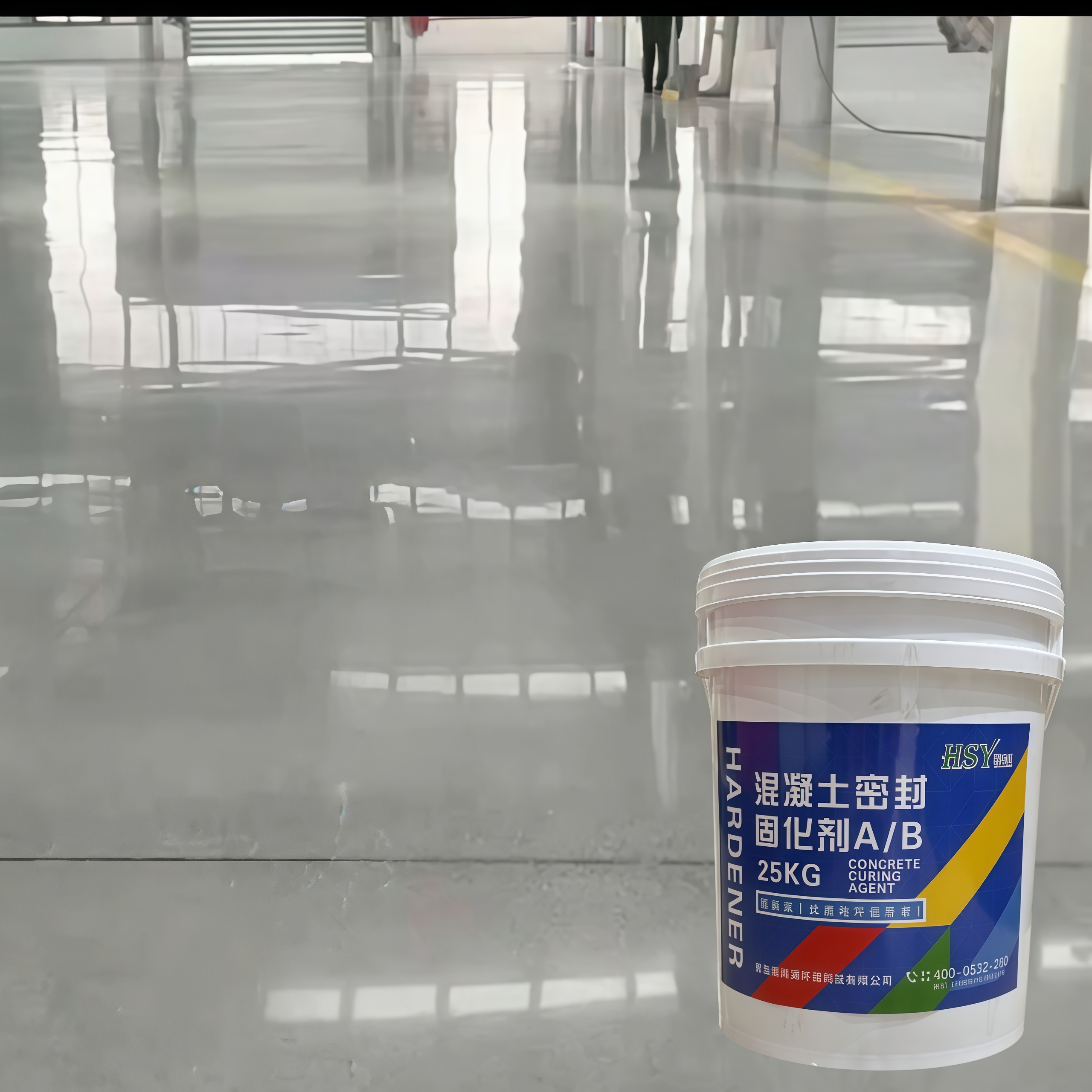
In industrial workshops, logistics warehouses, underground parking lots, shopping malls, and other high-traffic areas, concrete floors often suffer from dusting, sanding, oil stains, poor wear resistance, and short service life. Concrete sealer hardener has become the first choice for new floor construction and old floor renovation with its core advantages of penetration reinforcement, long-term durability, and low maintenance.
What is Concrete Sealer Hardener?
Concrete sealer hardener is a colorless, transparent, water-based, non-toxic, and VOC-free liquid material composed of silicate/lithium-based active substances. It penetrates deeply (3–10mm) into the concrete and chemically reacts with free calcium and calcium hydroxide inside to form calcium silicate hydrate (C-S-H gel). This reaction fills capillary pores and forms a three-dimensional dense structure, making concrete harder, denser, and dustproof from the inside out.
It is not a surface coating, but a material that strengthens the concrete itself—one construction, long-term benefits.
Core Advantages of Concrete Hardener Floors
- Ultra-High Hardness & Wear Resistance: Improve Mohs hardness from 3–5 to 7–8, increase wear resistance by more than 300%, and significantly enhance compressive strength. Resist forklift rolling and heavy object impact without damage.
- Permanent Sealing & Dustproof: Seal capillary pores to completely eliminate dusting and sanding at the source, meeting cleanliness requirements for workshops, warehouses, medicine, food and other scenarios.
- Anti-Permeation & Easy Cleaning: Resist water, oil and stains penetration; daily mopping is enough for cleaning, greatly reducing maintenance costs.
- Long Service Life: Lasts more than 15–20 years under normal use, far longer than the 5–8 year service life of traditional floors, reducing downtime for renovation.
- Eco-Friendly & Safe: Water-based, solvent-free, VOC-free, compliant with green building materials and food/medical hygiene standards.
- Increasing Gloss with Use: Self-polishes with daily use, gradually showing a warm marble-like luster.
Wide Application Scenarios
- Industrial: Production workshops, logistics warehouses, equipment manufacturing plants
- Commercial: Underground parking garages, supermarkets, shopping malls, exhibition halls
- Public: Hospitals, schools, airports, stations, stadiums
- Renovation: Repair of old cement, terrazzo and emery floors with sanding problems
Standard Construction Process
- Base Treatment: Grind to remove laitance, repair cracks and holes, clean and dry the base surface
- Penetration & Curing: Spray hardener evenly, keep wet for full absorption
- Grinding & Polishing: Fine grind with graded polishing pads to improve density and gloss
- Curing & Forming: Light load available after 24 hours, optimal performance achieved in 7 days
Key Points: Temperature ≥5℃, clean and dry base surface, full penetration, uniform coating
Lithium-Based vs. Sodium/Potassium-Based: Which to Choose?
- Lithium-Based Hardener: Deeper penetration, more sufficient reaction, less alkali-aggregate reaction, uniform gloss, suitable for high-standard projects and long-term use
- Sodium/Potassium-Based Hardener: Cost-effective, easy construction, suitable for general industrial floors and budget-limited projects
Conclusion
Concrete sealer hardener is not just a floor treatment material, but a long-term investment in floor performance. It solves the pain points of traditional concrete floors, reduces later maintenance costs, and creates a clean, durable and high-quality ground environment for various scenes.
Whether it is new floor construction or old floor renovation, choosing high-quality concrete hardener and professional construction can bring you a maintenance-free high-performance floor for decades.