
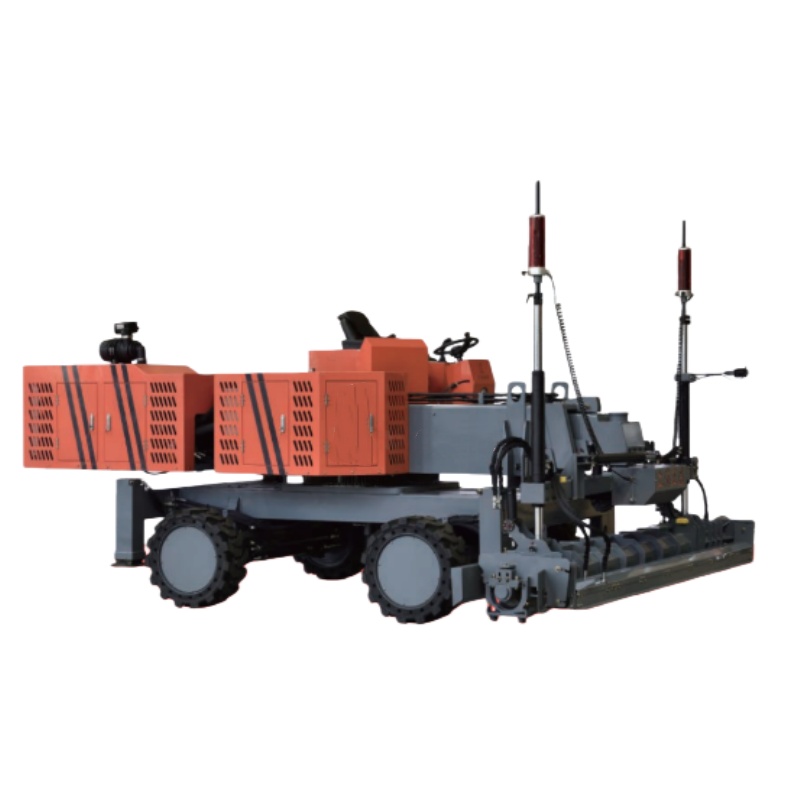
At construction sites of large commercial complexes, airport terminals and logistics warehousing centers, the once dense crowd of workers for floor construction is being replaced by “steel craftsmen” — floor grinders integrated with autonomous navigation, automatic grinding and dust collection are reshaping the ecological pattern of the floor construction industry with the core advantages of multiplied efficiency and sharply reduced costs, emerging as a hard-core tool for cost reduction and efficiency improvement in the engineering field.
Bid Farewell to the “Human Sea Tactics”: A Single Machine Replaces 70% of Labor
Floor construction has long faced the industry pain points of “labor shortage, high costs and low efficiency”. Under the traditional manual grinding mode, a large number of skilled workers are required to cooperate in the operation, and the construction quality is uneven due to differences in physical strength and technical level. For the annual 1.2 million square meters of stone floor maintenance project at Beijing Capital International Airport, 35 professional operators would be needed if the traditional manual method is adopted, along with high safety risks and management costs. After the introduction of intelligent grinding robots, a single machine can achieve a daily operation area of over 4,000 square meters, labor input is directly reduced by 70%, and the grinding uniformity is improved by more than 40%, completely getting rid of the reliance on the “human sea tactics”.
According to the 2024 research data from the China Building Materials Circulation Association, in projects using multi-functional floor grinders, the average construction time per unit area is shortened by 27.6%, and labor costs are reduced by about 31.2%. At the Guangdong Haihua Headquarters Park Project, intelligent grinding robots realize 24-hour uninterrupted operation, and the single-day construction efficiency is more than three times higher than that of traditional manual work. The emery floor grinding project that originally required multiple workers to spend several days on can now be completed by only one operator with the cooperation of the equipment. This “1 person + 1 machine” operation mode has become the preferred solution for large-scale project construction.
Technology Empowerment: From “Mechanical Replacement” to “Intelligent Quality Improvement”
The labor-saving advantage of floor grinders stems from the continuous iteration of technology. Modern grinding equipment has evolved from an early mechanical auxiliary tool to a “construction robot” integrated with multiple intelligent systems: equipped with a navigation and positioning system and a path planning module, it can automatically identify obstacles such as columns and fire hydrants, achieve a grinding coverage rate of more than 95%, and eliminate the problems of missing grinding and over-grinding; the pressure sensing and automatic adjustment technology can real-timely adjust the grinding force according to the ground material, control the flatness error within the millimeter level, far exceeding the precision of manual operation; the supporting automatic dust suction and collection system not only solves the problem of dust pollution in traditional construction, but also reduces the labor input for special cleaning personnel, and the 100L large-capacity material barrel can greatly reduce the replacement frequency.
The technical advantages are more prominent in large-area floor construction scenarios. The “one-time forming mechanical grinding and troweling construction method” promoted by the Beijing Municipal Commission of Housing and Urban-Rural Development, in the ultra-large area floor construction of 42,000 square meters, through the combination of sub-bin pouring and mechanical grinding, completely replaces the manual troweling process, which not only avoids quality defects such as floor hollowing and cracking, but also reduces the labor demand to one-third of that of the traditional process. The high-efficiency characteristic of floor polishers makes their operation efficiency more than 10 times higher than that of manual work, and the surface strength and finish of the treated ground have reached a level unattainable by manual work.
Cost Restructuring: Short-Term Investment Brings Long-Term Returns
For construction enterprises, floor grinders not only bring direct labor savings, but also realize systematic optimization of comprehensive costs. Under the traditional manual grinding mode, enterprises have to bear multiple expenses such as workers’ salaries, social security, training and industrial injury risks. The annual cost of a skilled grinder exceeds 100,000 RMB, and personnel turnover is likely to lead to production capacity fluctuations. Although intelligent grinding equipment requires initial investment, it can operate stably for many years, the average annual converted cost is gradually reduced, and the hidden costs such as rework and supplementary grinding can be reduced through standardized operation.
The practice of Southern Construction Co., Ltd. of Hunan Construction Investment Group shows that after the introduction of intelligent grinding robots, the project not only saves 10% of labor costs, but also shortens the overall construction period by nearly 30%. The project originally planned to be completed in 33 months can be delivered in 24 months. In the stone maintenance industry, the popularization of multi-functional floor grinders has reduced labor costs by more than 35%, becoming the core driving force for the transformation of the industry to mechanization and intelligence. This cost structure of “short-term investment and long-term benefits” is prompting more and more small and medium-sized enterprises to join the equipment upgrading ranks.
Industry Transformation: An Inevitable Choice from “Construction” to “Intelligent Manufacturing”
With “green and smart” becoming the main theme of the development of the construction industry, the application scenarios of floor grinders are constantly expanding, extending from industrial plants and underground garages to high-standard places such as airports, high-speed railway stations and stadiums. Behind it is the profound transformation of the construction industry from a “labor-intensive” to a “technology-intensive” one — no longer relying on cheap labor, but achieving a dual breakthrough in efficiency and quality through technological innovation.
From the four-disc floor troweling robots at the construction site of Chongqing East Station to the intelligent grinding equipment at the Wuhan Union Hospital Chongqing Hospital Project, these “new Lubans” not only work faster and more economically, but also redefine the standards of floor construction with the advantages of zero safety accidents and high-quality output. In the future, with the in-depth integration of the Internet of Things and AI technology, floor grinders will realize more precise intelligent control and more efficient collaborative operation, further compress labor demand, and push the construction industry into a new stage of “less human intervention and unmanned operation”.
At a time when labor costs are rising continuously and engineering quality requirements are becoming increasingly strict, floor grinders are no longer an optional “upgraded equipment”, but a “necessary weapon” for enterprises to enhance their core competitiveness. This construction revolution driven by technology is making “cost-saving, high-efficiency and high-quality” the new normal of floor construction, and also injecting strong impetus into the high-quality development of the construction industry.