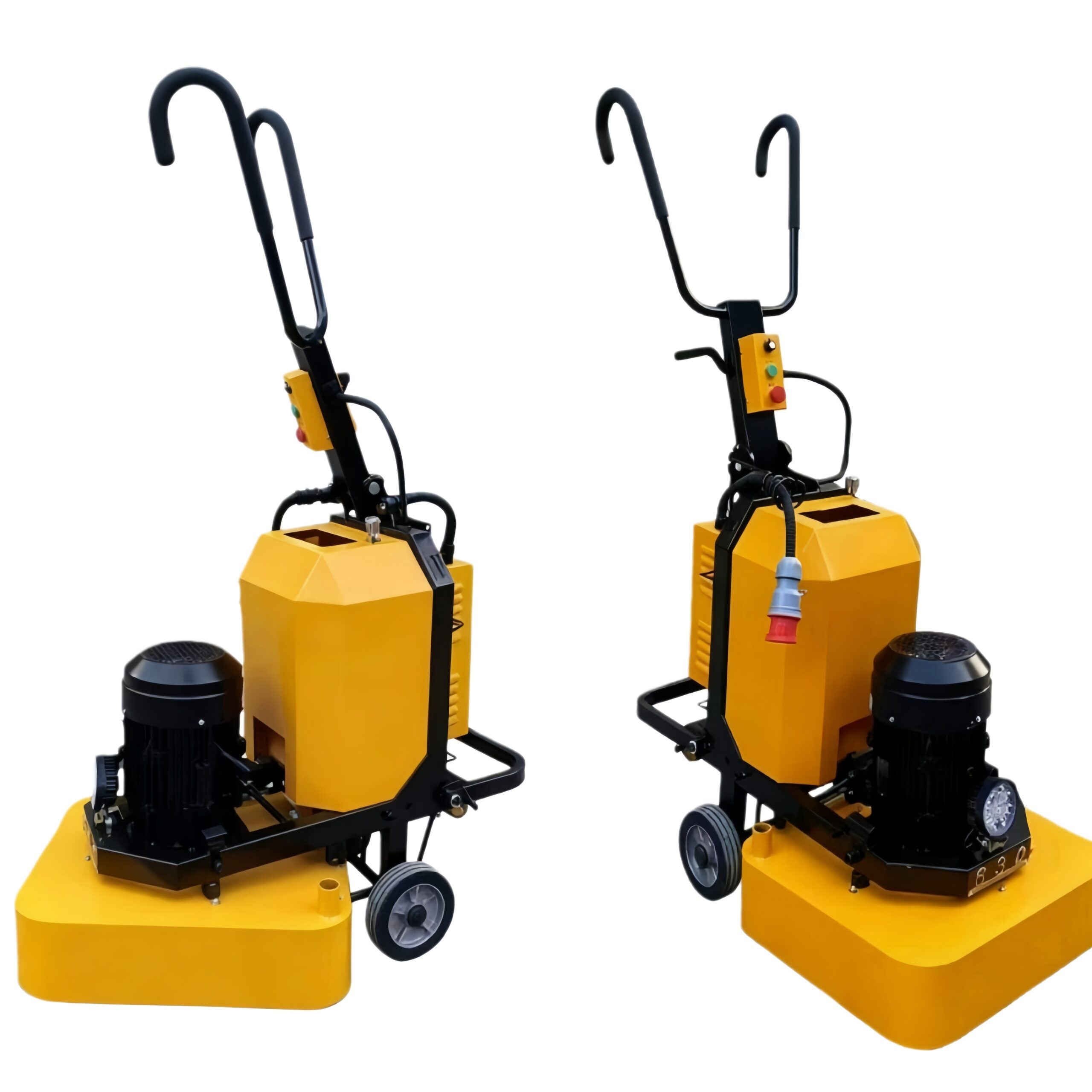
Against the backdrop of advancing construction industrialization, accelerated urban renewal, and the widespread adoption of green construction principles, floor grinders—as core equipment for surface treatment—are seizing dual opportunities in technological upgrading and market expansion. Industry data shows the global floor grinder market reached $391.47 million in 2025, and is projected to grow to $412.92 million in 2026, representing a CAGR of 5.49%. The domestic market is equally dynamic: sales of multi-functional floor grinders exceeded 65,000 units in 2025, a year-on-year increase of 13.4%, with mid-to-high-end models featuring intelligent sensing and dust-free operations accounting for more than 51% of the market for the first time. An industry transformation centered on technological innovation, guided by environmental protection, and targeted at scenario adaptability is now in full swing.
New Development Trend: Value Upgrade from “Tools” to “Integrated Solutions”
In the past, floor grinders were regarded as simple electric grinding tools, focused solely on surface grinding and polishing. With the expansion of downstream applications—from industrial workshops and logistics warehouses to commercial complexes and underground parking lots—the value positioning of floor grinders has fundamentally shifted. Today, they serve as integrated solutions incorporating electric drive technology, gear transmission, intelligent control, and dust removal systems, whose performance directly determines construction efficiency, quality, and cost control.
Technological iteration is the core driver of industry upgrading. On one hand, intelligent technologies are rapidly penetrating, with LiDAR navigation, fully automatic grinding, and remote control becoming increasingly common. For instance, in the underground parking lot construction of Poly Xinhui City in Chancheng District, Foshan, a floor grinding robot achieved precise navigation via LiDAR and fully automated grinding, supported by remote-controlled edge finishing, greatly improving efficiency over traditional equipment. In a project in Pengjiang District, Jiangmen, a 60-year-old operator controlled a grinding robot using a tablet, achieving 1.4 times the efficiency of conventional machines.
On the other hand, green development has become a mandatory requirement. The Ministry of Industry and Information Technology’s Green Manufacturing Project Implementation Guidelines (2021–2025) specifies that construction equipment must meet at least Grade 2 energy efficiency standards. By 2026, the penetration rate of green-compliant floor grinders is expected to exceed 60%. Dust suppression and noise reduction technologies such as dual-plate dual-suction systems and wet grinding are widely applied, effectively resolving industry pain points such as dust emissions and noise pollution, aligning with construction needs under China’s “Dual Carbon” strategy.
In terms of application scenarios, the industry features diversified and tailored development. Planetary floor grinders dominate the market with over 50% share for large-area treatment. Ride-on and remote-controlled models are widely used in large public construction projects for large-scale operations. Manufacturers offer customized machines for epoxy, terrazzo, and concrete curing floors to achieve multi-functionality. For example, the 650-drive dual-plate grinder is designed for epoxy flooring with self-propelled systems and dual dust collectors for dust-free efficiency. The Molege 900 heavy-duty grinder, with 450–500 kg grinding pressure and a 25 kW main motor, easily handles medium-to-high hardness surfaces in complex conditions.
New Market Competition Landscape: Dual Drivers of Technology & Service, Entering an Era of Rational Purchasing
Rapid market expansion has shifted competition from price wars to comprehensive competition in technology, service, and branding. Among nearly 100 domestic floor grinder manufacturers, only a few possess core R&D capabilities, complete supply chains, and full lifecycle services. Buyers now prioritize value over low cost, focusing on four key dimensions:
Technical Competitiveness
Independent R&D of core components forms industry barriers, with PLC control systems, high-performance motors, and intelligent algorithms as core strengths. The Kingfuss N85 floor grinder uses a programmable logic controller for more stable signal transmission and stronger anti-interference performance than traditional relay controls. In a logistics warehouse project in North China, it operated continuously at high intensity for two months without control system failures, ensuring on-time project delivery. Leading enterprises achieve in-house production of core components, with invention patents and practical application results measuring corporate strength.
Scenario Adaptability
The ability to cover industrial, commercial, and public construction scenarios with customized solutions is a key measure of equipment value. Large workshops demand wide grinding width and high stability; underground parking lots require compatibility with confined spaces and edge finishing; old floor renovation needs efficient grinding and coating removal. Wet/dry dual-use designs and multi-head configurations further expand adaptability to diverse construction needs.
Customer Validation
Benchmark projects and quantified results directly reflect strength. After adopting the Orca Hero 900 floor grinding robot, a Singaporean flooring firm reduced a 3-person workload to a single operator, significantly improving efficiency and quality, with coverage in Lianhe Zaobao. In domestic logistics parks and high-end workshops, premium grinders shorten construction periods and cut labor and material costs by over 30%, becoming critical tools for cost reduction and efficiency improvement.
Full-Lifecycle Service Capacity
After-sales response, parts supply, and technical support directly affect equipment efficiency. Industry surveys show a 23% construction delay rate caused by poor after-sales support and delayed parts delivery—a major buyer concern. Manufacturers with comprehensive service networks provide 24/7 troubleshooting, on-site upgrades, and operational training, ensuring stable equipment performance from pre-sales consulting to post-sales maintenance.
Future Development Trends: Deep Integration of Globalization & Intelligence Unlocks New Growth
From 2026 to 2030, the floor grinder industry will maintain steady growth, with the global market expected to surpass $569 million by 2030. The Asia-Pacific region, the most dynamic growth pole, will see annual demand growth of over 7%. Global expansion and intelligent upgrading will become two core trends.
Accelerated Global Layout, with Asia-Pacific as the Growth Core
Rising infrastructure investment in Southeast Asia and the Middle East, combined with accelerated overseas expansion by Chinese enterprises, is boosting international demand. Driven by China’s urban renewal, India’s infrastructure boom, and manufacturing relocation in Southeast Asia, the Asia-Pacific has become the global growth engine. Leading Chinese enterprises are expanding overseas through international exhibitions, local offices, and optimized cross-border supply chains, focusing on high-standard markets such as Japan, South Korea, and Singapore. Compliance with international certifications such as CE and UL has become a basic threshold, with companies aligning with global standards gaining first-mover advantages.
Deep Integration of Intelligence & Digitization Reshaping Construction
AI and IoT technologies will drive floor grinders from automation to intelligence. Future equipment will support remote monitoring, self-diagnosis, and intelligent scheduling, with real-time cloud data upload enabling digital and refined project management. For example, CRM-connected equipment data accurately tracks efficiency and material consumption for cost control. Intelligent algorithms automatically optimize grinding parameters based on floor materials and conditions. Synergy between grinders, industrial vacuums, and curing agent sprayers will form a complete flooring construction ecosystem, enhancing integrated operations.
Balancing Green Performance & Durability for Sustainable Development
Under the “Dual Carbon” goals, low-energy, low-emission, and low-noise grinders will dominate the market. Manufacturers are upgrading motors, adopting eco-friendly materials, and improving dust removal systems. Wear-resistant materials and reinforced structures enhance durability, extend service life, and reduce lifecycle costs. Exploration of equipment remanufacturing and recycling will further support sustainable development and reduce resource waste.
Practical Recommendations for Procurement & Application: Precise Selection for Efficient Project Delivery
Amid a complex market, construction companies and buyers should follow industry trends to optimize selection and reduce costs:
- Prioritize core needs and scenario matching: Choose ride-on/remote-controlled models for large areas and handheld units for small spaces or edges. Select grinders with suitable precision and head configurations for epoxy, curing, and other floor types.
- Value technology and service to avoid risks: Partner with manufacturers holding core patents and complete after-sales systems, focusing on control stability, dust removal, parts supply, and response speed. Avoid low-cost unknown brands that often cause delays and extra costs due to high failure rates.
- Strengthen training for higher efficiency: Organize professional training before operation to ensure mastery of startup, parameter adjustment, and troubleshooting. Reliable manufacturers typically provide free training and guidance.
- Maintain regularly to extend lifespan: Establish standardized maintenance, inspect motors, gearboxes, and grinding discs, clean dust removal systems, and replace consumables. Avoid overloading to prolong service life.
The floor grinder industry stands at a new starting point for high-quality development, with technological innovation and market demand jointly unlocking growth potential. For construction enterprises, choosing the right equipment and partners is key to seizing opportunities and achieving sustainable growth. With deeper progress in intelligence, green development, and globalization, floor grinders will deliver core value across more scenarios, powering the transformation and upgrading of the construction industry.